 Stuff Everybody Knows
Dunning-Kruger & Impostor Syndrome
Why everyone thinks they're average, and why that's dangerous
Before we talk about any technology at all, we need to talk about the psychology of learning, because it affects everything else you’re going to do in your career.
The Dunning-Kruger effect
In 2000, two psychologists named Dunning and Kruger published a study about how good people are at estimating their own abilities. They gave participants some objectively measurable tasks — math, logic, grammar — and then asked those people to rate how well they’d done, and to rate how well their peers had done.
The results were fascinating.
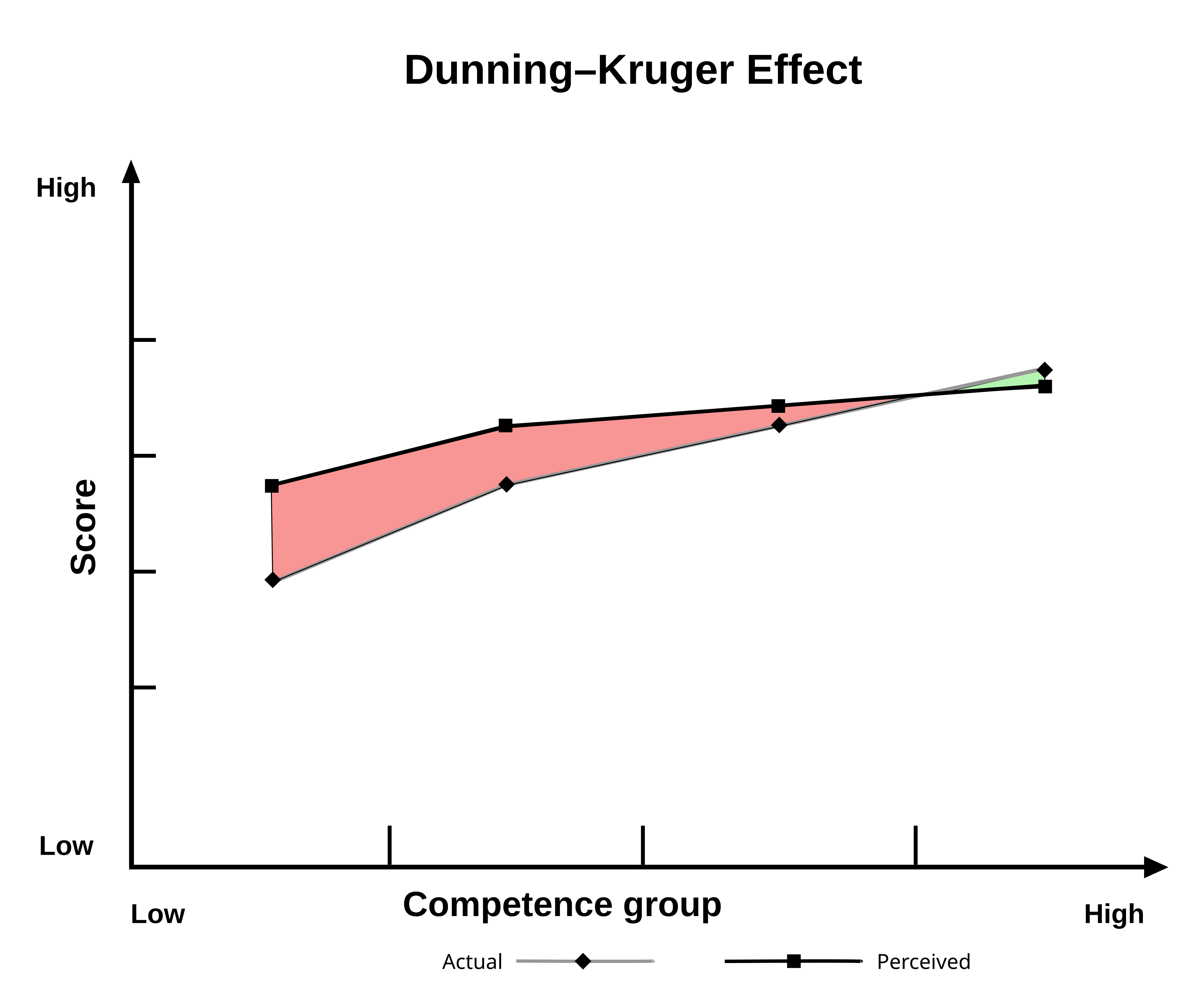
The top quartile — the people who were objectively really good — thought they were just about average. They undervalued themselves. They also overestimated how good everyone else was. You probably recognize this as impostor syndrome: when you’re so good at something that it feels easy, and because it feels easy, you assume you’re not trying very hard, and therefore you must not be that good at it. And because it feels easy to you, you assume it must be easy for everyone else too.
Impostor syndrome is dangerous because it makes you vulnerable. If you’re already predisposed to think you’re not that great, it’s very easy for an arrogant jerk to walk in and convince you of it.
The bottom quartile — the people who were objectively not good — also thought they were about average. But the really interesting part is what happened when you asked them to rate their peers: they were basically a random number generator. They couldn’t tell who was good and who was bad, because they were so unskilled that they didn’t even know what good looked like.
You are probably already thinking of somebody you’ve met who was like that. Makes sense now, right?
Dunning-Kruger bottom quartile people are in trouble. If you’re bad at something and you don’t know you’re bad at it, you have no feedback mechanism. You can’t get better because you can’t tell you’re doing it wrong. The good news is there’s a way out: the same study showed that focused mentoring from somebody experienced was enough to get you to a place where you are good enough to at least know that you’re bad. At that point, you have a hill to climb, and you can get genuinely great. Bootcamps are good at getting you over that initial hump.
You know you’ve exited the bottom quartile when one day you wake up and think: Oh no, I know nothing. I’m overwhelmed by my own ignorance. That feeling of being crushed by how much you don’t know is actually the moment you’ve created a feedback mechanism. It means you’re fine.
The uncomfortable middle
Another really dangerous part of this finding is that both groups — the excellent and the terrible — feel the same way about themselves. They both feel “about average.” So if you’re sitting there feeling pretty okay about yourself, you’re either really excellent or really terrible, and there’s no way for you to know which one.
This creates a delicate psychological balancing act: you can’t let anyone give you grief about your abilities (because you might be great), but you also have to stay humble (because you might be terrible). So don’t take any shit from jerks, but remember you might be the jerk.
Implicit bias is real and terrible
The way out of this particular trap is to cultivate a community of your peers. People who know you, and who you trust enough to give you honest feedback, can help you figure out if you’re great or if you’re terrible. They can help you exit the bottom quartile if that’s where you are.
But a key part of that is that they must be your peers. If you’re from an under-represented group in technology, which is to say anybody other than a straight white male, you’re going to find you get feedback from people who are not like you, and in fact have deep, implicit biases against people like you. They will tell you that you are worse than you are, and they won’t even be aware that they’re doing it. It’s not their fault, but you should still ignore them.
What if I am a straight white male?
If you happen to be the group that tech loves most, you have a different job. You’re going to find your career suspiciously easy. Systems you won’t even notice that are set up to find and promote people like you will be acting in your favor, whether you want them to or not. That’s what privilege is, and you can’t opt out of it. So instead you have to wear it like a suit of armor, and go to battle for other people.
You can be the one who says “hey, they just made a great point” when somebody who is routinely ignored is being ignored. You can make a fuss when the conference only picks straight white dudes as speakers. You can make sure the hiring pool is diverse. You can put ladders down behind you so other people can make it up.
With this basic understanding of how wrong you are about most things most of the time, it’s time to start learning, starting with automating everything.